Women's Chainmakers Festival 2026
The Walsall NASUWT Teachers' Union, works to protect the status of the teaching profession and deliver real improvements to teachers' and school leaders.
Posted 24/06/2026 14:23:18
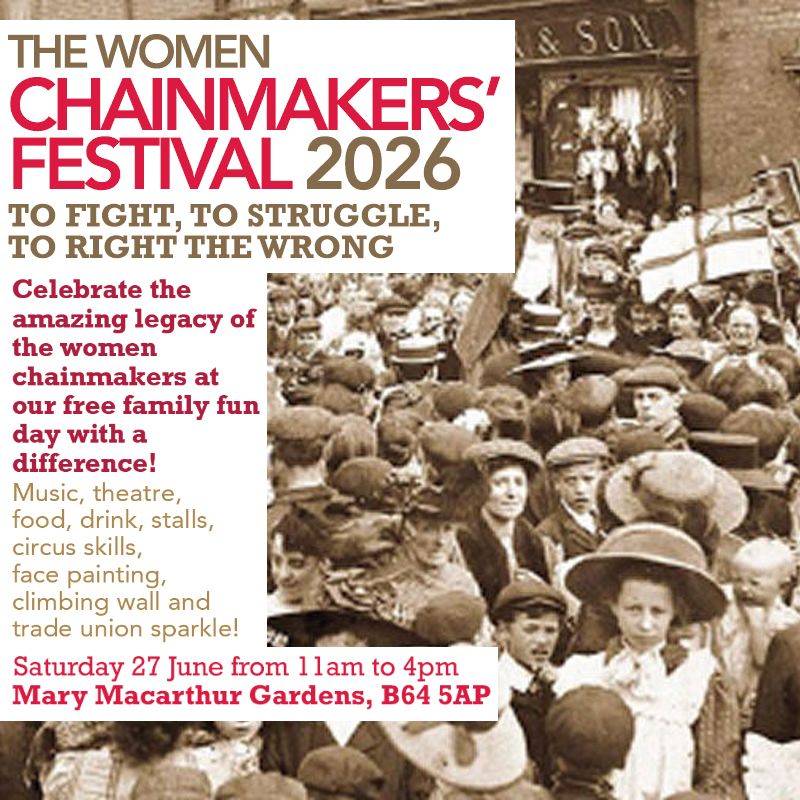
At the turn of the 1900s, the Black Country was the centre of chain making in England. Heavy and medium chains were made by men in factories, but lighter chains were made by women and children, typically in dark, cramped outhouses behind their homes.
They welded each link by hand, working with the most basic of tools, usually a hammer and a pair of tongs. It was hot, dirty and very poorly paid.
Thanks in no small part to the work of Mary Macarthur, both through her involvement with the Anti-Sweating League and her own organisation, the National Federation of Women Workers (NFWW), 1909 saw the government pass the Trade Boards Act. This established regulatory boards and minimum rates in four low-paid trades, including chainmaking.
A few employers paid the new rates immediately, but most took refuge in a clause that allowed them to delay increasing pay until 17 August 1910. In the meantime, they resorted to underhand measures. A loophole in the Act allowed workers to contract out of the new rates for a further six months. Unscrupulous bosses and middlemen used this time to trick or force women into signing away their rights to the new rates of pay.
Very few of the women could read or write. Many signed without understanding what they had done. Those who refused were simply told that there was no work for them. Meanwhile, the bosses were stockpiling chains made at the old price. Their plan was to sell these stocks when the new rates became legally binding. They would make the majority of women unemployed, and render the Trade Boards Act unworkable. On 23 August, when the women’s union, the NFWW, drafted another agreement stipulating that the minimum rates should be paid immediately, the employers stopped supplying the women with materials and recalled the iron rods which had already been delivered to their workshops. The women retaliated by going out on strike – the ‘Cradley Heath lockout’ had begun.
Organising a strike was no easy matter, but the NFWW had an experienced and determined leadership in Mary Macarthur, Julia Varley and Thomas and Charles Sitch. They used community engagement and the media to build massive support and donations to keep the strike going. The strike went from strength to strength. By the start of September, a number of companies agreed to pay the new rates, but it was necessary to keep up the pressure. In the second week of September, the women chainmakers secured the support of the Trades Union Congress (TUC) meeting in Sheffield. The congress pledged the women chainmakers the moral and financial support of the whole organised labour movement. The strike continued to build and, by 19 October, the women had won their victory! The women’s victory was to have a huge impact right across the labour movement. The success of the dispute motivated many to see the benefits of organising in trade unions. The Women Chainmakers’ Festival celebrates that legacy. It is coordinated by TUC Midlands, bringing together trade unions and community groups to host the only Trade Union run festival to celebrate the success of women.